A Beginner's Guide to Kitesurfing
What the sport actually is, how you learn it, and what to expect from your very first course.
If you have watched someone skim across the water under a kite and thought "I could never do that" — you almost certainly could. Kitesurfing looks like an extreme sport and feels like a skill, and it is far more learnable than it appears from the beach. This guide covers what you actually need to know before your first lesson.
What is kitesurfing?
Kitesurfing means riding a small board across the water while a large, curved kite pulls you along with the wind. You steer the kite with a control bar and wear a harness around your waist, so most of the pull goes through your core rather than your arms. Get the kite in the right part of the sky and it does the work; your job is to guide it and balance on the board.
It is closer to sailing than to surfing in one important way: you are managing wind, not chasing waves. That is also why the right conditions matter so much when you are learning, and why flat, shallow lagoon water is the ideal classroom.
The four stages of learning
Every good beginner course follows the same logical order. You do not move on until the stage before it feels natural, which is exactly why it works.
- 1
Kite control
You start on land and in shallow water, learning to steer the kite smoothly and understand where it has power. This is the single most important skill, and it comes before anything else.
- 2
Body dragging
On a full kite in waist-deep water, you use the kite to pull yourself along without a board. It teaches power control and how to recover your board later, a genuine milestone.
- 3
The water start
Board on your feet, you learn to time the kite so it lifts you up and gets you planing across the water. The first few metres of riding feel like magic.
- 4
Riding and going upwind
You link your rides together, control your speed and learn to ride back to where you started rather than drifting downwind. This is the point where you become independent.
The gear, in plain English
- The kite — inflatable and steerable, sized to the wind strength. Lighter wind, bigger kite.
- The bar and lines — how you steer, sheet in for power and activate the safety release.
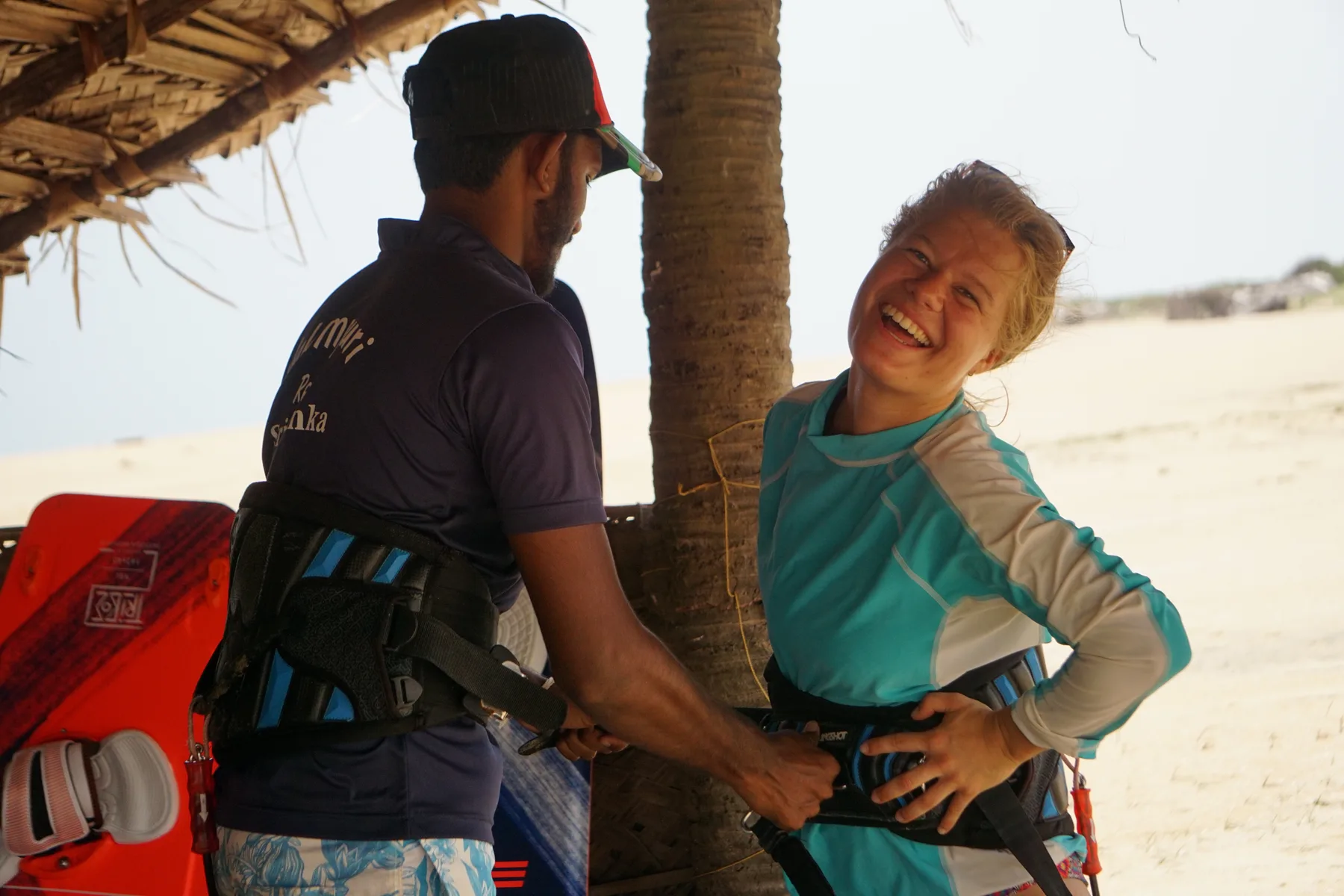
- The harness — sits around your waist and takes the kite's pull off your arms.
- The board — a twin-tip, ridden in either direction, with foot straps or pads.
- Helmet, harness & radio — for lessons we include a helmet with a radio so your instructor can coach you on the water.
How long until I can ride?
Most people reach independent riding in around 9 to 12 hours of lessons, spread over three to five days. Some get there a little quicker, some need a few extra hours. Both are completely normal. The variables are your conditions, your coach and whether you rush the early stages. We break the numbers down in detail in how long does it take to learn.
Where should a beginner learn?
Conditions make or break the experience. As a beginner you want flat, shallow water you can stand up in, steady and predictable wind, and space away from crowds and hazards. Kalpitiya Lagoon in Sri Lanka is one of the best beginner spots in the world for exactly these reasons: a huge, waist-deep flat-water lagoon with reliable seasonal wind. Read more about learning in Kalpitiya.
Ready to go from reading to riding? Our complete beginner course takes you through all four stages, and our packages combine it with a place to stay.
Beginner questions
The basics, answered
What is kitesurfing, exactly?
Kitesurfing (or kiteboarding) is riding a small board across the water while a large, steerable kite pulls you along using wind power. You control the kite with a bar and are attached by a harness around your waist, so the pull goes through your body, not your arms.
Is it hard to learn?
The first few hours are the steepest part of the curve; after that it gets easier fast. Most complete beginners reach independent riding in about 9 to 12 hours when they learn in good, flat-water conditions with a qualified instructor.
What is IKO and does it matter?
The IKO (International Kiteboarding Organization) sets the global standard for kite instruction and safety. Learning at an IKO-affiliated centre means a structured, internationally recognised progression and instructors trained to teach it safely.
Do I need my own equipment?
No. For lessons and courses we provide the kite, board, harness and a helmet with radio communication. You only need your own gear once you are riding independently and want to rent or buy.
Start with a real conversation, not a booking form
Tell us where you are starting from and we will recommend an honest plan (course length, dates and price) before you commit.
Ask us anything